How to play
Everything you need before your first case. It takes about four minutes to read, and you can forget most of it — the app does the arithmetic.
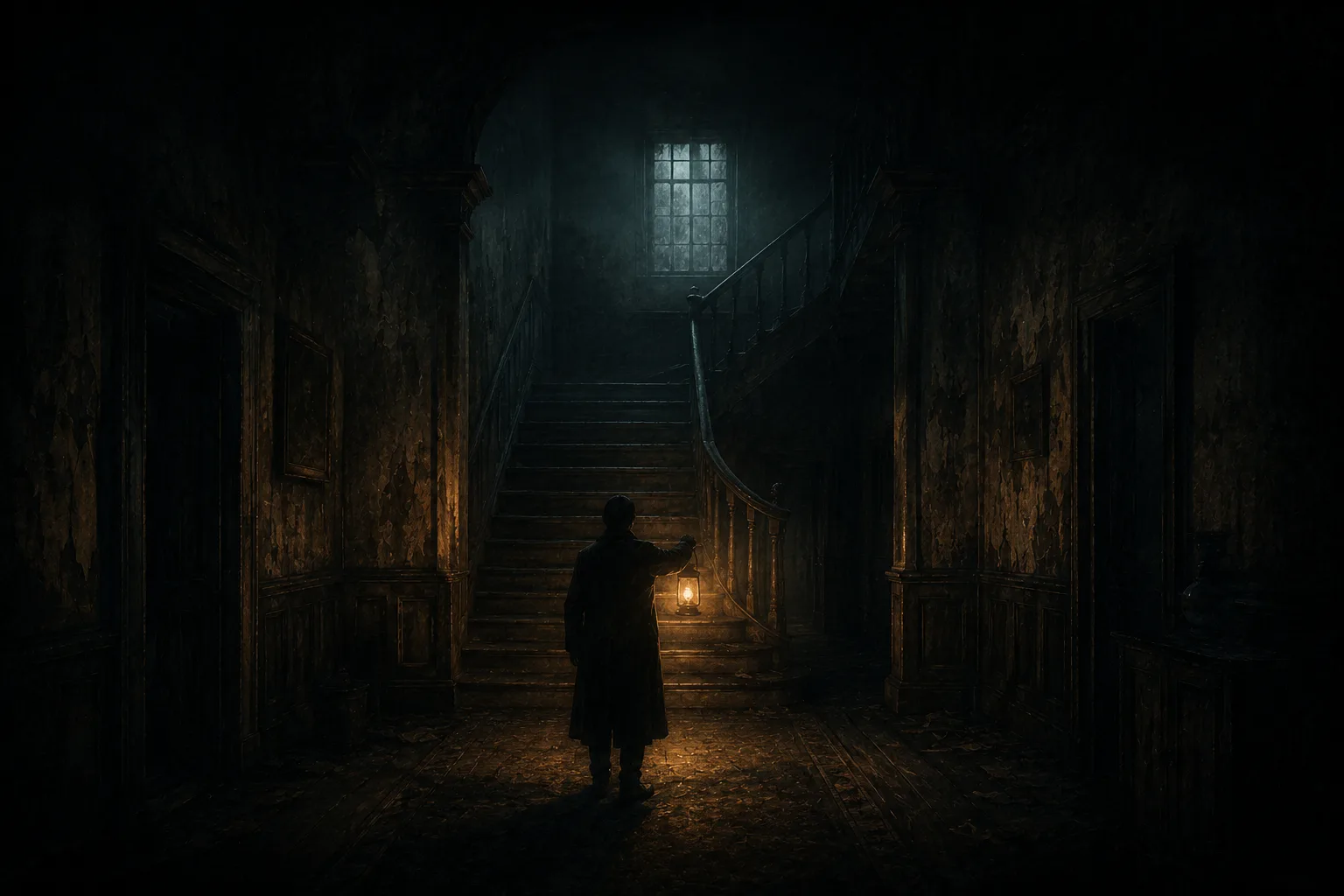
You play one investigator in a horror mystery. You type what they do, in your own words. An AI Keeper narrates what happens next, plays everyone else in the world, and decides when something is uncertain enough to need dice.
The app rolls every die. The Keeper never rolls, never invents your numbers and cannot quietly change them. When a roll is called for, a panel appears with the skill and your chance in it; you press the button, the dice fall in front of you, and the result goes to the Keeper to narrate. That division is the whole design: the story is improvised, the mechanics are not.
One roll, and what it means
Everything is a percentage. Your investigator has a rating in each skill — Climb 40, Persuade 55 — and a roll of a hundred-sided die at or under that rating succeeds. Low is good. There is at most one roll per turn, and only when failing would actually cost you something; routine things simply work.
The five outcomes are stamped beside the dice in the log, so you can always see how well or badly a thing went, not just whether it worked.
Difficulty
Difficulty never adds hidden modifiers to your roll. It changes the number you are rolling under, and the panel shows you the changed number before you throw.
When a roll fails: a turn of fortune
A failure stands. There is no re-rolling it and no pool of points to buy your way out — but you are alone out there, so once per scene you may call on fortune after a failed roll.
The app then makes your Luck roll. It does not repeat the attempt: what it decides is whether chance leaves you a way round the failure — another approach, a second door, someone arriving, the thing not lost after all. Succeed and the Keeper must give you that break, concretely, in the scene. Fail and the consequence lands in full. Fumble it and you are worse off than if you had never asked. Your sheet shows whether this scene’s turn is still in hand.
Your investigator
You build one before the first scene: characteristics rolled on dice, a profession, skill points spent, a face drawn if you want one. The sheet sits down the side of the play screen and everything on it is live.
Sanity, and what it costs to know things
When your investigator witnesses something the world should not contain, the Keeper calls for a Sanity roll and the app rolls the loss — a little on a success, more on a failure. Lose enough at once and their mind gives way there and then: the app rolls what form that takes and how long it lasts, and the Keeper plays it out with you.
Your maximum Sanity also falls as you learn what is really out there, and it never comes back up. At zero, the investigator is gone — not dead, but no longer someone who can be played. As Sanity drops you will notice the interface itself going wrong: the colour drains, the edges close in, the room starts to breathe, and the portrait on your sheet stops being the person who sat for it. None of that is decoration. It is the only warning you get.
The party
You may take up to 3 companions — full investigators, built exactly as yours is. The Keeper plays them, not you: you can ask, argue and send them somewhere, and they answer in character. The app still rolls their dice on their own sheets, and they bleed, break and die like anyone else. Click a companion’s name to read their whole sheet — which is how you find out that the doctor beside you cannot pick a lock.
Fights and chases
When a fight starts, a strip appears above the story listing everyone in it in order, with their wounds. A chase gets its own strip showing the ground between you and whatever is behind you, closing a location at a time. Both are there so that the most frightening things in the game cannot be resolved in one vague sentence.
The case board
Everything you are handed — documents, photographs, the illustrations you have had drawn — is pinned to a corkboard, threaded by the chapter it came from. Your notebook lives there too: the Keeper writes down what your investigator learns, and you write down what you think it means. Half of solo play is the theory you build on that board.
How hard it presses
Peril is a dial on your sheet, and you can move it at any time. It changes how much warning a threat gives and how often the world pushes back — never the dice, which are always honest.
Death is possible at every setting, including the gentlest.
Getting better, and dying
A skill you use successfully when it matters is marked, and between adventures you roll to see whether it improves. If your investigator dies, the case does not end with them: the file, the evidence, the notes and the board all stay, and you continue as somebody new — a fresh investigator, or one of the people the scenario has already put in the room.
A note on the rules
Midnight Mythos runs on a percentile system used under the ORC License — an open licence for tabletop rules. The turn of fortune above is our own addition for solo play. Attribution in full is on the licence page. If you want to bring a scenario you already own, read the terms of use first.